GI Tag Handloom Certification Saree: How to Read Authenticity Labels
GI tag handloom certification saree labels hold the key to authentic Indian craftsmanship—yet most buyers misunderstand what these marks actually guarantee. Textile specialist Priya Menon explains what GI tags, Silk Mark, and Handloom Mark truly mean, how to verify them, and why these certifications matter for Indian-American saree lovers seeking real artistry, not just marketing.
What is a GI Tag Handloom Certification Saree?
GI tag handloom certification saree means the saree is woven in a specific region, using time-honored techniques, and its authenticity is verified by a Geographical Indication (GI) tag issued by the Indian government. GI tags protect the cultural heritage of handloom textiles, ensuring buyers receive the real craft, not imitations. For example, a Kanchipuram silk saree with a GI tag is physically and culturally linked to its Tamil Nadu origin, protected by law.
The GI tag, Silk Mark, and Handloom Mark are distinct but related markers. Each signals a different aspect of authenticity: region, material, or handcraft technique. For Indian-American women seeking genuine tradition in their festive wardrobe, understanding these labels is essential.
Why Certification Matters in Saree Buying
Certification is not just a marketing tool—it is a buyer’s first defense against deceptive blends, powerloom lookalikes, and mass-produced imitations. In today’s globalized saree market, handloom weavers from Kanchipuram, Varanasi, or Chanderi face intense competition from industrial mills. Certification marks like GI tag handloom certification saree labels, Silk Mark, and Handloom Mark India help preserve artisan livelihoods and guarantee you receive what you paid for.
For instance, Kanchipuram sarees have been handwoven for over 400 years, with each piece requiring laborious pit loom weaving and authentic mulberry silk. The GI tag protects these traditions and ensures genuine pieces carry a traceable origin.
What Each Saree Certification Means: GI Tag, Silk Mark, Handloom Mark, India Handloom Brand
| Certification | What it Certifies | What it Does NOT Certify | How to Verify |
|---|---|---|---|
| GI Tag | Region of origin and traditional method (e.g., Kanchipuram, Banaras) | Material purity, handloom status | Look for GI logo, QR code, hologram; verify on official GI registry |
| Silk Mark | 100% pure natural silk fiber content | Handloom weaving, regional origin | Check for Silk Mark hologram; verify with Silk Mark Organisation of India |
| Handloom Mark | Woven on a handloom by Indian artisans | Fiber purity, regional origin | Look for India Handloom Mark label; cross-check with Handloom Export Promotion Council |
| India Handloom Brand | Handloom, quality, and unique regional features | Always GI protection | Brand tag + registered serial number; confirm via India Handloom Brand portal |
How to Spot an Authentic GI Tag Handloom Certification Saree
To confirm a saree’s authenticity, check for these trust signals:
- GI Tag: Look for a GI logo, hologram, or QR code on the saree’s tag (especially for Kanchipuram, Banarasi, Chanderi, and Paithani sarees). Cross-check the registration number on the official Geographical Indications Registry of India.
- Silk Mark: A yellow or blue hologram label issued by the Silk Mark Organisation of India confirms pure silk content.
- Handloom Mark: This label, issued by the Handloom Export Promotion Council, guarantees the saree is woven on a handloom, not a powerloom.
Tip: Genuine handloom sarees often have minor irregularities in the weave—such as subtle variations in the motif alignment or slight thread tension changes—especially visible on the reverse side. Machine-made sarees tend to be perfectly uniform.

Origin & Craftsmanship: Why It Matters
Every region’s saree has a unique story. For example, Kanchipuram silk sarees are woven with mulberry silk from South India and zari from Gujarat, using a three-shuttle technique on pit looms. Banarasi sarees, protected by a GI tag since 2009, use fine silk and metallic zari in intricate brocade patterns, often employing the kadwa (hand-brocade) technique. Chanderi sarees blend silk and cotton, prized for their sheer texture and motifs inspired by Madhya Pradesh’s temple architecture.
When you choose a GI tag handloom certification saree, you’re supporting entire artisan communities and preserving cultural legacies.
How Are GI Tag Sarees Made?
- Raw Material Selection: Mulberry silk or high-grade cotton is sourced from traditional suppliers.
- Yarn Preparation: Yarns are dyed in small batches, often using vat or natural dyes to achieve region-specific hues.
- Warping & Wefting: Artisans set up the warp (vertical threads) and insert the weft (horizontal threads) on a handloom, following age-old patterns.
- Weaving: Pit looms or frame looms are used, with skilled weavers creating signature motifs (like temple borders or butis) by hand.
- Zari Work: Pure silver or gold-plated threads are incorporated for traditional sarees, especially in Kanchipuram and Banaras.
This process, overseen by regional master weavers, takes anywhere from a week to several months depending on intricacy.
How to Care for Certified Sarees
- Washing: Always dry clean pure silk or zari sarees. For cotton or mul cotton, hand wash gently in cold water with mild detergent.
- Drying: Avoid direct sunlight, which can fade colors—air dry in the shade.
- Storing: Fold sarees along the zari lines, wrap in a muslin cloth, and store in a cool, dry place. Avoid plastic covers for long-term storage.
- Ironing: Use a low-heat setting; for silk, place a thin cotton cloth over the saree. For a full step-by-step, see our guide on how to iron a silk saree without damage.
Practical tip: To prevent zari tarnishing, add a dried neem leaf or silica gel packet to your storage box.
How do I verify a Handloom Mark is genuine?
To verify a Handloom Mark, examine the label for the India Handloom Mark logo and a unique serial number. Cross-check this number with the Handloom Export Promotion Council or request proof of registration from the retailer. Genuine handloom marks feature tamper-evident holograms and are never simply printed stickers.
Criteria: What to Look for Before Buying
- Certification: At least one of GI tag, Silk Mark, or Handloom Mark for the fabric you choose.
- Origin: Confirm the saree’s region—Kanchipuram, Banaras, Chanderi, Paithani, etc.—and ask your retailer for provenance details.
- Material: Pure mulberry silk, cotton, or mul cotton. Avoid ambiguous blends unless explicitly labeled.
- Craftsmanship: Irregularities in weave or motif placement are a good sign. Uniformity may indicate powerloom.
- Seller Transparency: Check if the retailer offers detailed product descriptions, care instructions, and supports video inspection for damages—like Swathi Design’s 48-hour video policy.
Budget Tiers: Saree Options for Every Price Range
- Under $100: Look for authentic mul cotton or Chanderi cotton sarees with Handloom Mark or regional GI tag. The Handcrafted Mul Cotton Ethnic Frock – Festive Elegance ($28) and Handcrafted Mul Cotton Ethnic Saree Dress ($35) are versatile choices for festive occasions or daywear—lightweight, artisan-made, and easy to care for.
- $100–300: Traditional silk sarees with Silk Mark or GI tag from certified sellers. Banarasi, Chanderi silk, or Bengal tussar sarees are often available in this bracket.
- $300+: Pure zari Kanchipuram or Paithani sarees with both GI tag and Silk Mark, often featuring complex handwoven motifs and heirloom potential.
For Indian-American buyers, a certified mul cotton or Chanderi suit is practical for California’s climate and festive occasions. The Elegant Mul Chanderi Silk Suit ($45) offers comfort, soft pastel hues, and handloom artistry for weddings and Diwali.

How to Style Certified Sarees & Dresses for Festive Occasions
GI tag handloom certification sarees and dresses are best paired with traditional or fusion accessories:
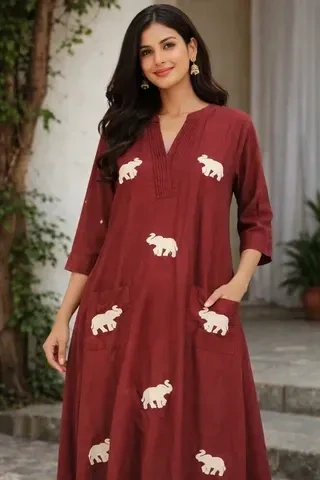
- Festive Look: Wear the Handcrafted Mul Cotton Ethnic Frock in mustard or maroon with bold jhumkas, embroidered juttis, and a gold-tone potli for wedding events.
- Modern Fusion: Try the Handcrafted Mul Cotton Ethnic Saree Dress with a leather belt and white sneakers for a brunch or casual gathering—see more fusion outfit ideas in our fusion outfit guide.
- Classic Festive: Pair the Elegant Mul Chanderi Silk Suit with statement gold jewelry and a silk clutch for Diwali or sangeet nights.
For sarees, always match the blouse fabric to the saree’s weight and sheen; learn more in our article on choosing blouse fabric.
FAQ: Saree Certifications & Authenticity
What does a GI tag guarantee on a saree?
A GI (Geographical Indication) tag on a saree guarantees that the product originates from a specific region and is made using traditional techniques unique to that area. It protects local artisans, ensures the saree's authenticity, and prevents misuse of regional names by industrial producers.
Is the Silk Mark the same as a GI tag?
No, the Silk Mark certifies that the saree is made from 100% natural silk, while the GI tag certifies regional origin and traditional methods. A saree can carry both if it is handwoven pure silk from a GI-protected region.
Which Indian sarees have GI protection?
Several Indian sarees enjoy GI protection, including Kanchipuram silk (Tamil Nadu), Banarasi silk (Uttar Pradesh), Chanderi (Madhya Pradesh), Paithani (Maharashtra), Baluchari (West Bengal), and Sambalpuri (Odisha). Each GI tag is granted based on region-specific weaving traditions.
How do I verify a Handloom Mark is genuine?
The Handloom Mark includes a tamper-proof hologram and a unique serial number. Check the number with the Handloom Export Promotion Council or ask the retailer for supporting documentation. The label should state "Handloom Mark – Government of India" and be securely attached, not just a paper sticker.
Shop the Collection
True artistry and heritage belong in every celebration. Explore GI tag handloom certification sarees, mul cotton frocks, and Chanderi suits sourced from Indian artisan weavers at Swathi Design. Browse our full collection or discover more Dresses for every occasion. For price confirmation, styling help, or certification details, reach out via WhatsApp—Swathi Design’s team ensures trust at every step.
Featured in this guide
Part of the Handwoven Silks: Chanderi, Tussar & Raw Mango guide collection.
Related guides
- Elevate Every Occasion: Handcrafted Indian Gowns & Frocks for Modern Celebrations in the USA
- Elevate Every Occasion: Pure Chanderi Pattu Silk Sarees for Indian-Americans in the USA
- Exquisite Russian Crape Silk Saree: Timeless Elegance for Every Occasion
- Luxurious Pure Russian Crape Saree: Timeless Elegance for Every Occasion
- Elevate Your Festive Wardrobe with Exquisite Handwoven Chanderi Sarees and Anarkali Dresses